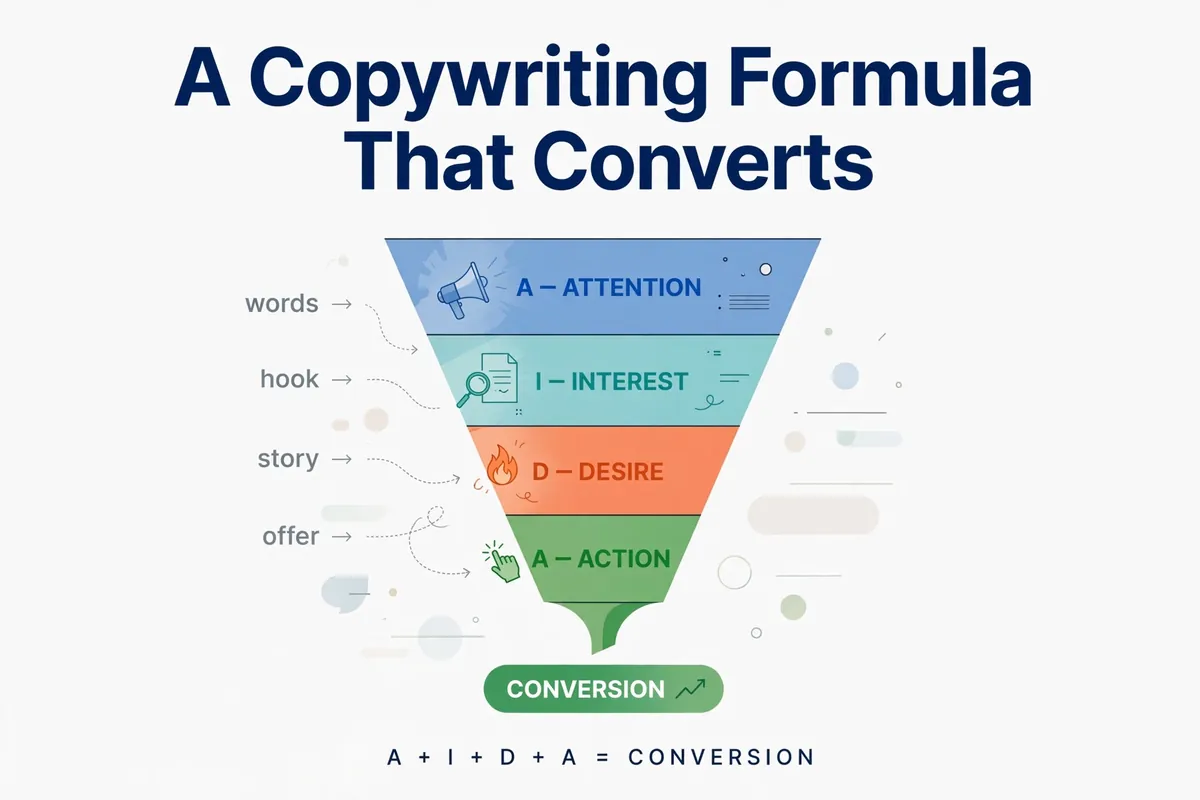
Copywriting sounds like a skill you need a masterclass for, but the highest-converting copy in the world follows the same four blocks every time. Whether you are writing a landing page, a launch email or a product description, the structure is identical: hook, problem, solution, close. This is that formula, plus examples, and a checklist you can reuse forever.
Step 1: The hook earns the next line
The reader is skimming. The hook's only job is to make them slow down for the next sentence. A good hook either names the outcome they want, the problem they fear, or the mistake they are making — in their words, not yours.
Weak: "Welcome to our new productivity pack."
Strong: "You are losing an hour a day to admin — and it is not your fault."
The second version wins because it states a specific pain the reader already feels and adds a twist (it is not their fault) that creates curiosity. Write the hook second, not first: once you know exactly what problem the reader has, the hook is the sentence that makes them recognise it.
Short on time? Get the done-for-you version
Grab LinkedIn Authority Formula ($15.00) and skip straight to results.
Get LinkedIn Authority Formula →Step 2: The problem creates tension
After the hook, name the problem fully enough that the reader feels "this person has read my diary." The trick is specificity: the cost of the problem in real terms (hours, money, stress) rather than vague discomfort.
Weak: "Managing client communication can be stressful."
Strong: "Between the Monday misread welcome emails, the thousand-item inbox and the client who texts at 9pm, you are not managing communication — it is managing you."
This block is where readers either lean in or leave, and the deciding factor is whether you have described their situation or the idealised version of it. Describe the reality. The reader recognises themselves, and recognition is the highest form of attention.
Step 3: The solution with proof
Now introduce the answer — and immediately back it with proof. The proof is the difference between an ad and a helpful pitch: a specific result, a case example, a number, or a mechanism that explains why it works.
Weak: "Our system reduces your workload."
Strong: "Our clients cut admin time by a third within two weeks, because the system handles replies, scheduling and follow-ups in one place — you approve the drafts instead of writing them."
Three proof layers, in order of power: a visible mechanism (this is how it works), a specific result with a timeframe, and a social proof like a named customer or testimonial. A mechanism alone is strong because it makes the promise feel mechanically possible rather than magical.
Step 4: The close moves the reader
The close has one job: make the next action obvious and effortless. It works in three beats — so what (restate the benefit), now what (a clean instruction), and why now (a reason not to wait). Most closings skip the "why now" and quietly die.
Weak: "Get started today."
Strong: "Grab the pack now and cut your first hour of admin this week — the setup takes fifteen minutes, and the first checklist is yours free."
Notice the close makes the cost small (fifteen minutes), the benefit immediate (this week), and the risk near zero (free first checklist). Every genuine objection you can pre-answer in the close removes a reason to click away.
The full formula on one page
HOOK      → [outcome / pain / mistake, in the reader's words]
PROBLEM   → [the cost in real terms; the reader recognises themselves]
SOLUTION  → [answer + mechanism + specific result + social proof]
CLOSE     → [benefit again + one clear action + a reason for now]
A before-and-after at full depth: a landing page for a meetup-agenda pack could open with "Your meeting is 22 minutes of noise and 8 minutes of work," name the cost ("three wasted hours a week across your team"), offer the fix ("agendas that end meetings earlier — here is the mechanism"), and close with the trial ("run your next meeting on it; it is free for your first agenda").
Apply it to every format
The formula scales down to a single tweet and up to a full sales page. Emails use the same four beats for the opening line, the body and the button. The discipline is always the same: one hook that earns the read, one pain stated in the reader's terms, one solution backed by a mechanism, one close that makes the next step effortless.
If writing is where you stall, the shortcut is not "be more creative" — it is collecting conversion copy so you never face a blank page. The Copy That Converts pack fills the formula with reusable pages, emails and subject lines, written and tested, so your block becomes choosing, not inventing.
Checklist for every piece you write
- Does the hook name a specific pain or outcome in the reader's words?
- Does the problem paragraph state a real, quantified cost?
- Is the solution backed by a mechanism, result, or customer proof?
- Does the close repeat the benefit, give one clear action, and offer a reason for now?
- Did I cut every sentence that does not advance one of the four blocks?
Run any page, post or email through this checklist and it will convert better without any new creative chops — because structure, not magic, is what the reader responds to.