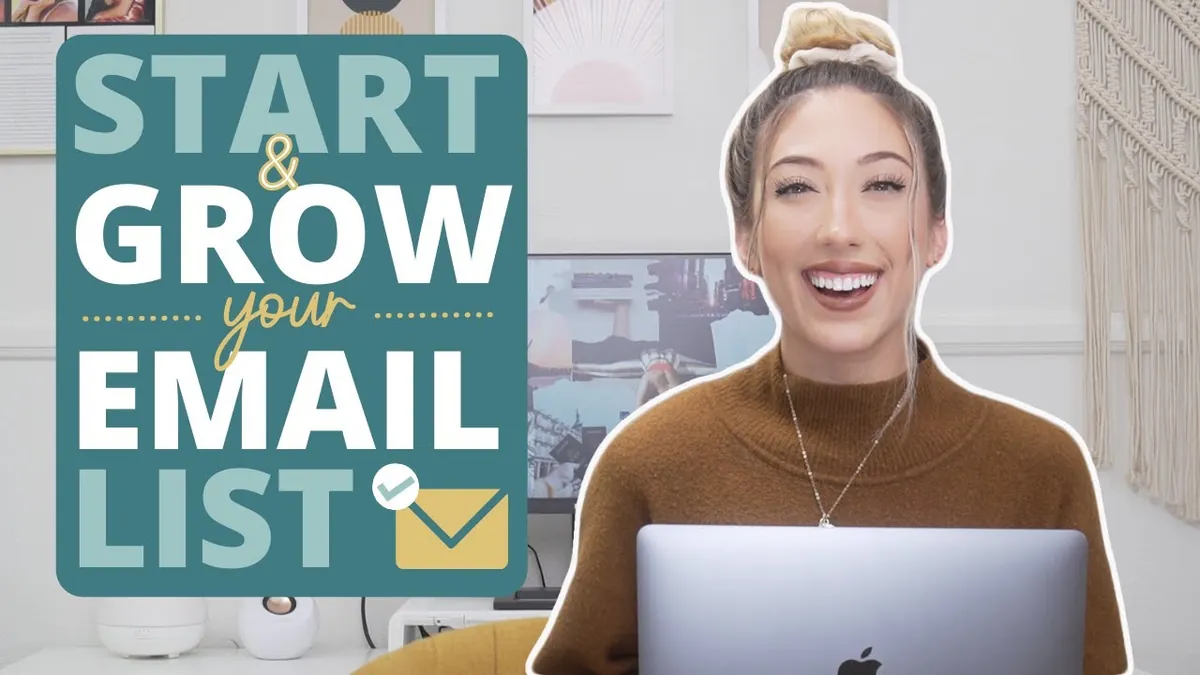
Email is the only channel you fully own. Social platforms rent you their audience; your list is yours forever, at whatever size it happens to be. The good news for solo businesses in 2026 is that you no longer need a paid ads budget to build one. You need a lead magnet people want, a page that asks for the email clearly, and a welcome sequence that makes new subscribers glad they joined.
Why email still beats the algorithms
Every social platform has the same economic model: you bring the audience, and it charges you more and more for the privilege of reaching them. Email flips the incentive. Each subscriber is a direct line you control — no shadowban rules, no shifting engagement penalties, no squeeze on organic reach.
Three numbers explain the whole case. Average email open rates in most niches sit between 35% and 45%, against a 1% to 2% engagement rate on social posts. Email drives roughly three times more purchases per visitor than social traffic. And the people on your list are the ones who already cared enough to give you their address, which makes them the highest-intent audience you will ever have.
Honest expectation: a 1,000-subscriber list is worth real money. A 10,000-subscriber list in a narrow niche is a business. You do not need an ad budget to reach either — you need consistency.
Short on time? Get the done-for-you version
Grab Email List Engine ($15.00) and skip straight to results.
Get Email List Engine →Step 1: Pick a lead magnet your audience actually wants
The lead magnet is the bribe — the free thing people trade their email for. The mistake most creators make is making the magnet about their own taste instead of the reader's pain. A good lead magnet answers one specific problem in a format that is immediately useful.
Lead magnets that convert best in 2026, roughly in order of strength:
- Checklist: "The 12-point remote-work setup checklist." Instant value, one page, zero fluff.
- Template: "Copy-paste meeting agenda templates." People love something they can use today.
- Cheat sheet: "50 AI prompts for busy operators." Dense, scannable, bookmarkable.
- Short PDF guide: "How we cut email time by 40%." A specific result with a short method.
- Video walkthrough: Only if you already produce video content easily.
Match the magnet to one clear audience. "Productivity tools for solopreneurs" is too wide. "A weekly planner that fits a part-time business" is narrow enough that the right people will feel it was made for them — and they will pay attention when you email them.
Step 2: Build a single-purpose opt-in page
One page, one job: get the email. Studies of landing-page behavior are consistent — when you show a single offer and a single form, conversion beats a homepage full of options because there is nowhere else to go.
A high-converting opt-in page needs the same five blocks in the same order: a headline that names the outcome ("Stop losing client emails in the chaos"), a one-paragraph description of what they get, a bullet list of what is inside, the email form with a clear button ("Send me the checklist"), and a privacy note. No navigation, no "about" link, no portfolio — you can link those later inside the emails.
The form itself should ask for exactly one field: the email address. Every extra field you add cuts conversions. If you collect the name at all, take it in the welcome process, not on the opt-in form.
Step 3: Choose a simple email platform
You do not need the most powerful email platform on day one; you need one that is easy and does not punish you for a small list. All the mainstream providers let you start free at a small subscriber count and grow from there.
When you compare platforms in 2026, look at three things only:
- Free plan limits — how many subscribers before you pay.
- Forms and automations — can it host the opt-in form or connect to your site's form?
- Deliverability — automated lists, double opt-in, and bounce handling are table stakes; make sure they exist and are on.
Double opt-in is the setting that stops spam complaints and keeps your sender reputation healthy. It costs you a fraction of signups who never confirm, but the ones who do confirm are genuinely engaged — which is exactly the list you want to own.
Step 4: Write the 5-email welcome sequence
The welcome sequence is where you actually start building the relationship, and it does the work of the first month of content in five days. A sequence this size is enough to move a subscriber from "this person gave me something free" to "this person is worth paying attention to."
Email 1 — deliver. Send the lead magnet, thank them, and tell them what to do with it first. Nothing else.
Email 2 — introduce. Your story in three short paragraphs: who you are, the problem you had, and what you now do about it. This is the email that builds trust faster than any other.
Email 3 — educate. One useful tip that actually solves a slice of the problem. Make them say "glad I opened this."
Email 4 — advocate. Share a case study or a result — someone who used the same method and got a win. Proof beats promises.
Email 5 — invite. A soft, honest offer: a product or service that directly solves the problem, with a clear one-line reason it matters. This is the first moment you ask for anything, and it is the moment the list starts paying you back.
Step 5: Add sign-up points across your existing content
You already produce content — articles, guides, social posts — so the fastest growth comes from attaching the lead magnet to the traffic you already have. Every article can carry a sign-up point in three places: an inline box after the second or third paragraph, a call-to-action at the bottom, and a mention in the sidebar.
This is also where a simple middle layer helps: a reusable signup snippet you can drop into any page instead of rebuilding forms each time. The article you are reading right now works this way — product offers and sign-up points are built into the content system once and reused everywhere.
The realistic numbers
Know the ranges so you can tell real progress from noise:
| Stage | What to expect |
|---|---|
| Free plan subscribers | 0 to 500 in the first 2-3 months is normal |
| Opt-in page conversion | 20% to 40% of visitors who reach the page |
| Welcome sequence open rate | 35% to 50% if the subject lines are honest |
| First offer conversion | 1% to 3% of the list per campaign |
None of these numbers require ads. They require a list you actually talk to, on a schedule, with emails that earn the open.
Common mistakes to avoid
- Buying a list — technically illegal in most places and always a deliverability disaster.
- Asking for too much — every extra form field cuts signups noticeably.
- Emailing once a quarter — a list that never hears from you forgets you.
- Making every email a pitch — your list dies the day it feels like a cash machine.
- Skipping the welcome sequence — it is the highest-engagement moment you will ever have; do not waste it with one bored "thanks for subscribing."
If the mechanics of this feel like errands rather than strategy, that is exactly where a done-for-you shortcut wins. A ready-built email engine gets you the opt-in pages, the welcome sequence and the campaign structure without you building them from scratch. The Email List Engine is the fastest version of the playbook above — templates included, strategy done for you.
Start this week, not after the perfect plan
The list grows one trade at a time: a free thing you can make this afternoon, exchanged for an address, treated with respect. Do that on a rhythm and the compounding takes care of the size. The only version of this that fails is the one you never start.