How to Validate a Digital Product Idea Before You Build It
Digital product validation means proving people will pay before you build. Run one cheap test — a pre-sale page, 20 cold emails, a community post — and watch for real money or a hard commitment. If the signal is weak, kill the idea in days instead of months.
Short on time? Get the done-for-you version
Grab The Digital Product Machine ($19.00) and skip straight to results.
Get The Digital Product Machine →That is the whole game. Every week somebody burns four months building a course nobody asked for, then acts surprised when it sells zero copies. Validation moves the rejection to a Tuesday afternoon, when it costs you $47 and an ego bruise.
Want the full system for idea → validated product with real buyers? The Digital Product Machine → Get it now
What is digital product validation?
Digital product validation is evidence — not compliments — that a specific person will pay a specific price for a specific outcome. Your mum saying "that's a great idea" is noise. A stranger typing their card number is data. Everything in this article exists to get you the second one fast.
Most advice gets this backwards. It tells you to ask your audience what they want. Asking measures politeness. Charging measures care. So my rule: an idea is validated when money moves or when a qualified stranger commits in writing, and not one heartbeat before that.
The 6-step digital product validation process
- Define the outcome. Define the one measurable outcome your product delivers, the person it's for, and the exact price you'll charge. Write it in one sentence.
- Find your target audience. Find 3 places your buyer already gathers: one subreddit, one newsletter, one Slack or Facebook group. Lurk before you post.
- Check demand. Check demand with Google Trends, Reddit search, and niche forums. You're hunting for repeated complaints, not polite interest.
- Pre-sell or survey. Pre-sell the product on a one-page offer, or at minimum collect emails with the price printed on the page.
- Run a minimum test. Send 100–300 targeted visitors to that page over 5–7 days. One traffic source, one audience, one offer.
- Decide go or no-go. Compare results against the kill number you wrote in step 1. Hit it, build. Missed it, kill it or revise the offer once.
On step 1: write the price down before you touch a page. If you're still hunting for what to sell, start from these side hustles that actually make money and work backwards to one clean outcome. Vague outcomes produce vague tests.
On step 4: a pre-sale page does double duty. It tests willingness to pay today, and every email you collect is a segment you keep forever — here's how to build an email list without ads using exactly this traffic before you decide anything.
On step 5: keep the test boring. Same landing page, same offer, one ad or one outreach batch. I draft the 20 message variants with my roundup of AI prompts for productivity; that's 20 minutes of work instead of an afternoon of staring at a blank doc.
Seven to fourteen days. That's the entire runway for most tests. If you can't decide in two weeks, your test is too fuzzy — not your market.
Which cheap test gives the strongest signal?
Five tests I've actually run, scored on what they cost and how loudly they tell you the truth. Prices and platform fees are as of October 2026 — check current rates before you commit.
| Cheap test | Typical cost | Effort | Signal /10 | What it proves |
|---|---|---|---|---|
| Landing page pre-sale | $10–40 page tool + $20–60 test traffic | 1 day | 9 | Strangers pay real money before the product exists |
| Gumroad waitlist / placeholder listing | Free to list; platform takes a cut on sales — verify current fees | 2 hours | 6 | People will click "buy" on a page that ships later |
| Kickstarter / crowdfunding | $0 upfront; platform + payment fees apply | 2–4 weeks | 8 | Mass-market pull — but slow and public |
| Cold outreach (20 emails) | $0 | 2 hours | 7 | Whether specific humans name the pain back to you |
| Reddit / community engagement | $0 | 3–5 days | 4 | Language and frequency of the complaint — not money |
Winner: the landing-page pre-sale. It's the only sub-$100 test where someone who has never met you hands over a card number. Kickstarter scores higher on proof but costs you weeks and a public failure if it flops. Reddit is where you do your homework, not your verdict — it tells you what people complain about, never what they'll pay for.
Where should you research demand?
Skip the generic "search your keyword" advice. These seven give you a specific answer each:
- Google Trends — the 12-month and 5-year slope. Rising, flat, or seasonal? A falling trend means you're pushing a tide, and no amount of copy fixes that.
- Reddit search — raw complaint language plus how often the same question recurs. Frequency beats subscriber count every time.
- AnswerThePublic / AlsoAsked — the exact phrasing buyers type. Steal it for your headline and your FAQ; it's free keyword research with intent attached.
- Indie Hackers and Show HN — what builders report actually selling, and the comment tone when someone pitches your idea. Silence in the comments is a finding.
- Amazon 3-star reviews on books in your niche. Five-star gushes and one-star rants both lie; three-star reviews name the missing chapter — that's your feature list.
- Gumroad Discover / Etsy search results — proxies for what already sells and what price ceiling the market accepts right now.
- Google Keyword Planner (broad ranges) — direction, not precision. Treat volume buckets as "this is a real category" or "this is a ghost town."
Spend two days maximum here. Research without a test is just expensive procrastination.
What does a real validation test look like?
Here's mine, numbers and all. In early 2024 I was convinced freelance translators needed a contract-and-invoice pack, so I wrote a one-page offer and bought $47 of traffic to it — 512 people landed on the page over nine days. Result: 3 pre-sales at $29. My written kill line was 10 sales or a 2% conversion rate. I got 0.6%.
So I killed it. Eleven days total, $47 spent, six weeks of building I never had to do. The next idea — a client-onboarding checklist for small agencies — passed the same bar in six days: 9 pre-sales from 340 visitors. I built it in a weekend, and its first month sold 41 copies at $29.
I'm not telling you validation always works. One sample isn't a pattern. I'm telling you the $47 bought me a decision, and the decision is the product.
How do you decide go or no-go?
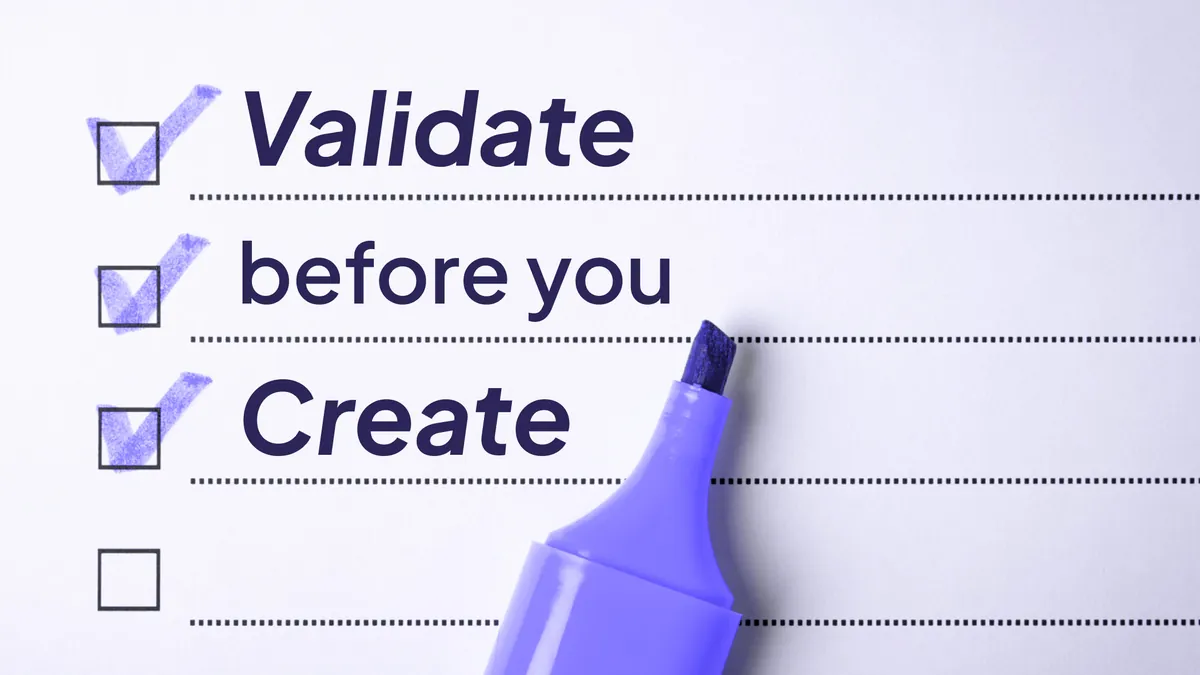
Decide before the data arrives. That's the entire discipline. Print this checklist, tick it with the test results in front of you, and don't move the goalposts afterward:
- ☐ At least 1–3 real pre-sales — money collected, not promises made
- ☐ Email conversion of 2% or better from genuinely qualified visitors
- ☐ 5+ unprompted replies describing the same pain in their own words
- ☐ Nobody blinked at your stated price — zero "how much?" replies
- ☐ You can name 3 repeatable traffic sources you can afford next month
- ☐ The test reached at least 200 relevant visitors (not friends, not bots)
- ☐ You'd still use this product yourself this month
5–7 ticks: build it. 3–4: revise the offer once and re-run the same test — one revision, not five. 0–2: kill it and take the next idea through the same six steps. A dead idea at day 12 is a win; a dead idea at month 5 is a divorce.
| Do this | Avoid this |
|---|---|
| Write the kill number before you launch | Deciding "one more day" for three weeks straight |
| Ask "would you pay $29 today?" | Asking "would you buy something like this?" |
| Test two audiences separately | Averaging feedback into a mushy maybe |
| Kill after one honest revision | Rebuilding the page five times to force a win |
| Treat silence as a no | Treating likes and upvotes as revenue |
Frequently asked questions
How long does digital product validation take?
7 to 14 days for a landing-page or cold-email test, including traffic. Crowdfunding runs 2–4 weeks. If your test needs longer than two weeks, you're changing too many variables — cut it to one offer, one audience, one number.
How much money do I need to validate an idea?
$0 to $100 covers almost every honest test. A free page builder plus $20–60 of traffic is enough to get 100–300 qualified visitors. Cold outreach and community research cost nothing but two hours. The expensive mistake isn't the test — it's skipping it.
What conversion rate counts as a pass?
For email-only pages, 2–5% from qualified traffic is healthy. For a real pre-sale, 1–3% is a strong pass — strangers paying is a much bigger ask than strangers typing an email. Below 0.5% twice in a row, with good traffic, means the offer is wrong, not the market.
Should I build an audience before validating?
No — validate first, then let the test build the audience. Every pre-sale page collects emails whether you pass or fail, so the experiment compounds. If you wait until you "have an audience," you've just invented a reason to postpone the only step that tells you the truth.
Can I validate an idea with zero audience?
Yes, and honestly it's the cleanest test. Cold outreach to 20 people who match your buyer, one Reddit thread asking about the problem (not pitching the solution), and $30 of traffic to a pre-sale page. No audience means no polite lies from friends — you only hear from strangers with credit cards.
Key takeaways
- Validation is money or a written commitment. Compliments, likes, and "I'd totally use that" are not data.
- Write your kill number before the test starts — that single sentence stops you negotiating with weak results.
- The landing-page pre-sale is the best cost-to-signal ratio: under $100, one day of setup, the strongest proof money gives you.
- Two weeks is the ceiling. Longer tests mean a fuzzy offer, not a quiet market.
- 5–7 checklist ticks means build, 3–4 means one revision, 0–2 means kill — and a fast kill is a good outcome.
Ready to run your first test? The Digital Product Machine turns this six-step process into a repeatable system — outcome worksheet, pre-sale page templates, and the exact go/no-go sheet I use, so you go from raw idea to a product with buyers instead of a folder of almosts.